

The tools available in a laboratory do more than enable experiments — they define their boundaries. Instrument selection shapes what questions can be asked, how reliably results can be reproduced, and at what cost research can scale. For this reason, shifts in the global scientific instrument industry deserve closer attention than they typically receive.
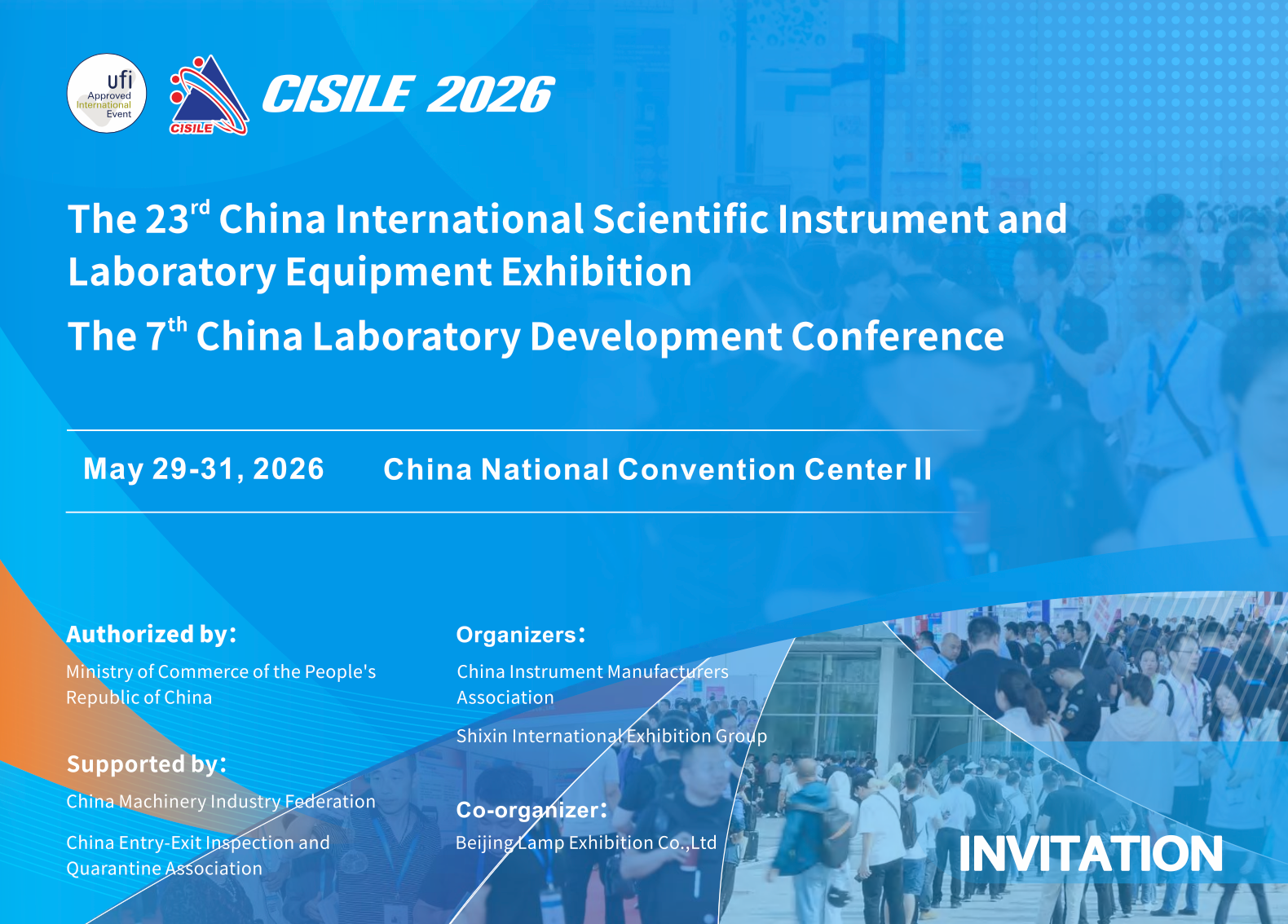
The 23rd China International Scientific Instrument and Laboratory Equipment Exhibition (CISILE 2026) takes place at the China National Convention Center Phase II in Beijing from May 29–31, 2026. Now in its 23rd edition — having successfully run 22 sessions — CISILE has earned recognition as one of China’s Top 10 Brand Exhibition Projects, a China Integrity Exhibition, and a UFI-certified international brand event. For researchers, procurement officers, and laboratory managers, it is worth understanding what the event represents: not merely a trade show, but a concentrated signal about where the industry is heading.
The Scale of the Event
The numbers give a useful sense of what CISILE has become. The 2026 edition spans 30,000 square metres of exhibition space, bringing together over 800 participating enterprises and expecting more than 50,000 professional visitors. A dedicated zone for fully automated laboratories has been added, reflecting where significant investment and interest are currently concentrated.
Running alongside the exhibition is the 7th China Laboratory Development Conference (CLC 2026), which brings academics, domestic and foreign experts, and enterprise representatives together for keynote sessions, paper presentations, and youth-focused forums. Also co-located is the 6th China Hazardous Chemicals Management and Laboratory Safety Forum. These are not peripheral events — they indicate that CISILE functions as a professional congress as much as a commercial exhibition.
Who Attends, and Why It Matters
The visitor profile is revealing. Previous editions have drawn representatives from the Chinese Academy of Sciences, Peking University, Tsinghua University, Shanghai Jiao Tong University, and dozens of state key laboratories. Major hospitals, national defense institutions, pharmaceutical companies, and industrial enterprises in sectors ranging from food processing to aerospace send procurement and technical directors. Government departments including the Ministry of Industry and Information Technology and the State Administration for Market Regulation are also represented.
The international dimension has grown steadily. The previous edition attracted audiences from 25 countries — including the UK, Germany, Japan, South Korea, Australia, Canada, and across Southeast Asia — with eight new countries added compared to the session before. Post-event surveys showed 98.5% of exhibitors satisfied with the overall result, and 99.53% of professional visitors reporting substantive benefit from attending. These are not figures that suggest a routine trade fair.
China’s Instrumentation Sector Has Moved On
The common perception of Chinese manufacturing — high volume, low complexity — has become increasingly difficult to sustain in the scientific instrument space. The exhibition scope at CISILE reflects how far the sector has broadened: from analytical and optical instruments to laboratory robots, biochemical and life science tools, smart laboratory and information management systems, environmental monitoring equipment, 3D printing, and non-destructive testing instruments. This is not a catalogue of commodity goods. It represents a sector actively competing across the full range of laboratory capability.
What has driven this transition is not only investment in technical capability, but a deliberate focus on cost-performance optimization and customization — two factors that carry real weight in procurement decisions, particularly for institutions managing constrained budgets without wanting to sacrifice functional quality.
What an Exhibition Reveals That a Catalogue Cannot
There is a structural limitation to sourcing laboratory equipment through distributors and online listings: the information available is curated, static, and filtered through commercial incentives. A trade exhibition operates differently. The same floor that displays a finished product also reveals the reasoning behind its design, the constraints its engineers worked within, and the applications it was actually built to serve.
At an event like CISILE, certain patterns become visible that are difficult to detect from a distance. Instrumentation is becoming more modular and application-specific rather than general-purpose. Equipment design increasingly prioritizes workflow efficiency over theoretical maximum performance — a practical orientation that aligns well with applied research, diagnostics, and high-throughput environments. Software integration, too, is playing a growing role: data handling, automation, and reproducibility are no longer afterthoughts in instrument design but central considerations. The dedicated fully automated laboratory zone at CISILE 2026 makes this shift explicit.
The Middle Ground Between Premium and Compromise
One tension that has historically shaped how global buyers approach Chinese suppliers is the perceived trade-off between cost and quality. That tension has not disappeared, but it has become more nuanced.
A growing segment of the market is no longer competing primarily on price. It is targeting the space between premium Western instrumentation and low-cost alternatives — offering reliable mid-tier equipment, scalable automation, and instruments engineered for specific workflows. For research institutions that do not require the absolute performance ceiling of top-tier systems, this middle ground has become genuinely interesting. The CISILE Independent Innovation Award, presented during the exhibition, is one mechanism through which the industry signals which domestic developments it considers technically significant.
The Value of Direct Engagement
For international buyers, CISILE creates conditions that are difficult to replicate through any other channel. Technical discussions that go beyond marketing materials, direct assessment of customization and OEM capabilities, clearer visibility into production standards — these are not things that transfer well through a distributor relationship or an online inquiry form. The presence of over 800 enterprises under one roof, across three days, compresses what would otherwise require months of separate sourcing activity.
The CLC 2026 conference running alongside the exhibition adds another dimension: access to the academic and institutional conversations shaping how laboratories in China are being designed, managed, and equipped. Understanding the demand side of the market — what research institutions are actually trying to build — is as valuable as understanding the supply side.
A Shift Worth Tracking
Scientific instrumentation has always been international — the movement of ideas, methods, and tools across borders is part of how science advances. What has changed is the degree to which China has become an active contributor to that system rather than simply a manufacturer within it.
CISILE 2026 is not the whole story. But for those trying to understand how the laboratory equipment supply chain is evolving — and what that means for research institutions worldwide — it is one of the most concentrated and honest views available.
At Scientific China, we follow this landscape as participants in the ongoing conversation between global research needs and the suppliers working to meet them. CISILE is one important point in that conversation. Understanding what it reveals is, ultimately, part of making better decisions in the laboratory.
CISILE 2026 takes place May 29–31, 2026 at the China National Convention Center Phase II, Beijing. Further information is available at www.cisile.com.cn.
 No products in the cart.